La figura dell’angelo nelle culture e nell’arte
(The figure of the angel in culture and art) – (December 2025)
Across various cultures, angels are recognized as spiritual beings, divine messengers, protective guides, and symbols of celestial or divine forces. They are often viewed as intermediaries between humankind and God, guardians of the faith, and, in some traditions, figures who intervene to protect and guide souls through life and beyond death. They fulfill numerous roles: serving as divine heralds, bridges between the sacred and the human, protectors, servants of God, and custodians of the cosmos.
Within catholicism, angels hold a foundational position. They play a crucial role in the Nativity, acting as divine messengers who announce the birth of Jesus to humble shepherds, thereby underscoring the spiritual significance of the event.
Gian Lorenzo Bernini frequently sculpted angels because they served as the ideal subject matter for his Baroque style, which aimed to evoke intense emotional and dramatic impact through sculpture. His angelic works are dynamic and highly expressive, embodying a grace and delicacy that—while far removed from Renaissance composure—achieve a lightness not always found in Baroque art.
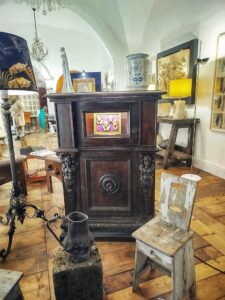
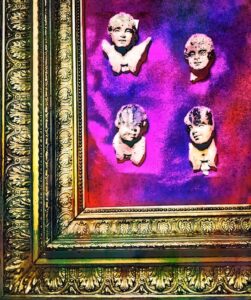
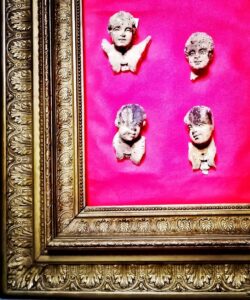
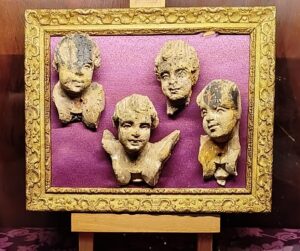
Displayed inside a rare Neo-Renaissance showcase, we present a selection of small angel heads (cherubim or seraphim). Our research attributes these pieces to the Giosafatti workshop from the Marche region (principally Giuseppe and Lazzaro), which was active between the second half of the 17th century and the end of the 18th century. Lazzaro, in particular, was sent to Rome to specialize in sculpture within the studio of Camillo Rusconi. Strongly influenced by the teachings of Gian Lorenzo Bernini and Ercole Ferrata, Rusconi is widely considered one of the major artistic figures of the first half of the 18th century. Through his time with Rusconi, Lazzaro mastered the style of Bernini’s bel composto (the beautiful synthesis of painting, sculpture, and architecture). Upon returning to the Marche, he transformed his family workshop into a hub of excellence capable of competing with major Roman commissions, creating a true school that influenced regional architecture and sculpture for over a century. Among Lazzaro’s works was the remodeling of the Teramo Cathedral (1739); unfortunately, this cannot be fully appreciated today due to ill-advised restoration projects, leaving only the St. Berardo chapel untouched. In Ascoli Piceno, he also worked for several minor patrons who are yet to be fully identified. Nevertheless, late 18th-century records and careful stylistic analysis allow us to identify portals, moldings, brackets, and broken pediments in various city buildings that can be confidently attributed to the Giosafatti workshop.