Accendiamo il Medioevo – The Spoltore Chapter
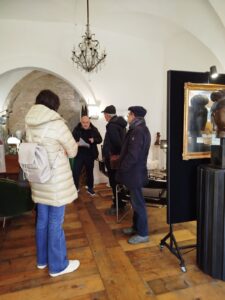
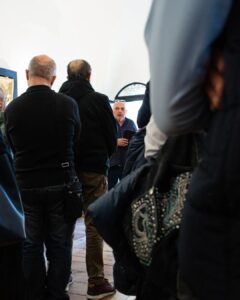
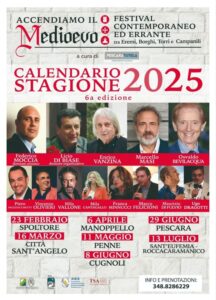
Our gallery proudly took part in the 6th edition of Accendiamo il Medioevo (Igniting the Middle Ages), an initiative curated by the cultural association Pescara Tutela under the artistic direction of Federico Moccia and the organizational leadership of Licio Di Biase. On Sunday, February 23, 2025, we had the pleasure of hosting the event’s participants right here in our gallery spaces.
The discussion centered on art within the historical context of the Middle Ages—a period defined by powerful cultural forces such as feudalism, the Inquisition, and the concept of Purgatory and penance. These elements heavily shaped the social fabric, leaving a profound mark on every aspect of life, including the world of art.
While the dominant architectural styles of the era—Pre-Romanesque (8th–10th century) and Romanesque (11th–12th century)—emphasized the close bond between humankind and God through the mediation of the Church, the Gothic period (13th–15th century) introduced a dramatic verticality. These soaring lines created an ideal physical extension toward the heavens, transforming art into a tool for direct dialogue between the individual and the Divine. Meanwhile, paintings predominantly featured striking, eschatological imagery like Last Judgments or apocalyptic visions. These were designed to magnify divine omnipotence while simultaneously serving as a tool for social control—the ultimate goal of the era. Indeed, according to the Church’s doctrine, art held no intrinsic value; rather, it was a utility for the moral and religious education of the faithful.
The medieval artist functioned primarily as a craftsman—the physical executioner of the work—while the philosophical direction and artistic framework were strictly dictated by the patron, whether a religious figure or a nobleman. Since the printing press would not be invented until 1450, art stood as one of the few available tools for communication and mass dissemination, making it a powerful instrument for social conditioning. The artist was stripped of freedom, both conceptually and executionally—marking a stark contrast to the free, expressive art found in the Lascaux caves some 19,000 years prior.
It was only with the Renaissance and the dawn of Humanism that humanity, rather than God, took center stage. This shift marked the beginning of a gradual liberation of the figurative arts from the grip of ruling powers like the Church and the State, signaling—both symbolically and historically—the true beginning of the modern era.